Let’s Talk about Children project concluded with final seminar in Brussels
A Finnish child- and family-focused intervention developed more than two decades ago has now been embedded into service systems across eight European countries. The EU-funded Let’s Talk about Children (LTC) project culminated in a final seminar in Brussels, bringing together more than 180 participants from 32 countries, both on site and online.
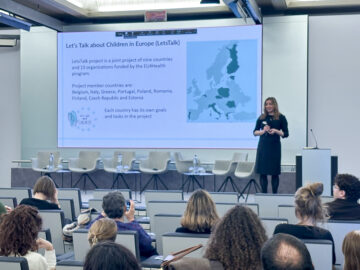
Originally developed at the Finnish Institute for Health and Welfare (THL), the Lapset puheeksi (Let’s Talk about Children) method has been implemented across Europe under the leadership of Kirsi Peltonen, Professor of INVEST Research Flagship Centre.
The three-year LTC project has coordinated the implementation of the intervention together with 13 European partner organisations, with the aim of strengthening the wellbeing of children and families by training local professionals in the method’s use.
During the project, more than 1,400 practitioners and 80 trainers have been trained, and nearly 3,000 families have been reached in Finland, Portugal, Romania, Greece, Italy, Estonia, Poland and the Czech Republic.
An evidence-based intervention for distressed families
The LTC method was developed by child psychiatrist and THL professor emerita Tytti Solantaus. In her address at the seminar, Solantaus emphasised that LTC is firmly grounded in research evidence and is a relational behavioural and cognitive intervention designed especially to support distressed families.
The intervention focuses on everyday life, routines and encounters, with the aim of ensuring that children’s developmental needs are met as well as possible across all life contexts. Rather than focusing solely on the child, LTC supports both children and adults, strengthening interaction, trust and mutual understanding within families.
Children’s mental health as a European priority
The seminar was opened by Member of the European Parliament Maria Ohisalo, who highlighted the growing challenges facing children and young people in today’s world.

“Every child has the right to grow up in a healthy, supportive and safe environment that paves the way to a good life,” Ohisalo stated. She referred to World Health Organization data showing that one in seven children and adolescents in Europe live with a mental health condition, and that the prevalence of mental health problems among young people has increased significantly over the past 15 years.
Ohisalo stressed that children’s mental health is not only an individual concern but a political one, calling for stronger EU-level action, cross-sectoral cooperation and better protection of children’s wellbeing, including in digital environments.
“It is our shared rsponsibility to ensure that to each and every child. I really want to thank you for your really important work, and I wish you a fruitful seminar,” Ohisalo said.
Voices from lived experience
A powerful perspective was also provided by lived-experience expert Pia Köpsi, who spoke about her experiences as a parent using the LTC method. Köpsi noted that while the method is not a solution in itself, it offers concrete tools such as safety and trust for encountering one’s own child.
“In situations where there is substance use in the family, the method helps adults see the world through the child’s eyes,” Köpsi explained. This shift made it possible to accept help and begin meaningful conversations where the child remains at the centre.
From practice to policy
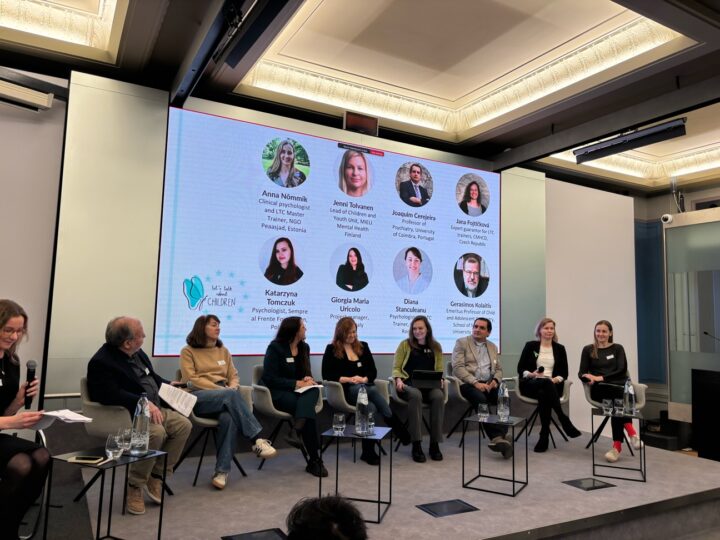
The seminar concluded with a panel discussion titled From Practice to Policy, moderated by Kadri Soova, Director of Mental Health Europe. The panel included Elizabeth Cosme (COFACE Families Europe), Marie-Cécile Rouillon (EU Child Rights Coordinator, European Commission) and Oana Felecan (Policy Officer, Equity & Well-being, DG EAC, European Commission).
Panelists underlined that the sustainable and comprehensive use of the LTC method requires long-term funding, projects and continued research. Despite the clear need and demonstrated impact, the future of the method remains uncertain in many countries without stable structural support.
Responding to Professor Kirsi Peltonen’s question on implementation experiences, panel members highlighted that LTC has helped open dialogue between parents and children without fear or shame. The method empowers both adults and children, reshaping how professionals and families approach mental health and everyday challenges.
As the project concludes, the seminar underscored a shared message: evidence-based, family-centred interventions like Let’s Talk about Children are urgently needed across Europe—but their long-term impact depends on political commitment, structural support and sustained investment.