INVEST Scientific Seminar XI Focused on Evaluating Reforms and Advancing Research
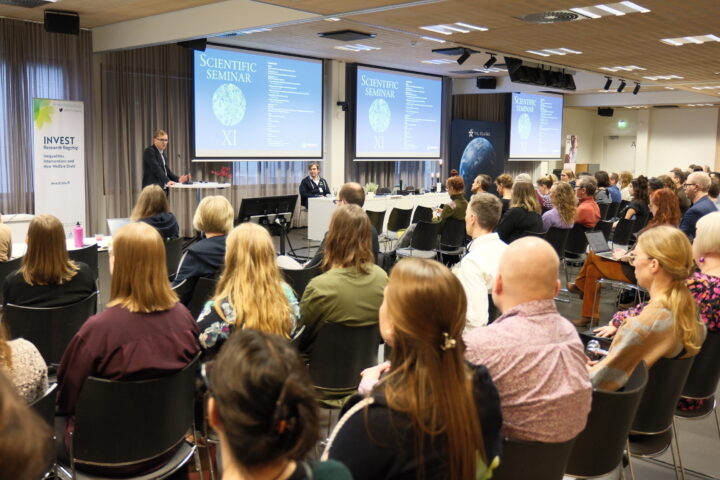
More than 120 researchers gathered in Helsinki for INVEST Research Flagship Centre’s annual Scientific Seminar, hosted this year at the Finnish Institute for Health and Welfare (THL). The day brought together lively discussions, 11 parallel working groups, and over 60 research presentations – all highlighting the breadth and vitality of INVEST’s research community.

In the opening remarks of the seminar, Flagship Director Professor Jani Erola (left) and Research Professor Pasi Moisio reflected on the year 2019, when the INVEST community last gathered – for the first time entirely as INVEST – at the Finnish Institute for Health and Welfare. Back then, the audience numbered around 20–30 people; this time, attendance had grown to over 120.
As 2026 marks the final year of INVEST’s current funding period, Erola noted that it is not yet time for a wrap-up. One milestone, however, was already shared: the new welfare state model promised in the funding application will be presented in a book to be published early next year. The coming year will also be crucial for defining INVEST’s future direction. While work on the next funding application is already underway, the process is not merely about securing continuation financially, but about reflecting on what to study next, which themes to emphasise, and how INVEST may expand in the years ahead.

A defining feature of this year’s INVEST Scientific Seminar was the strong focus on the centre’s renewed thematic research areas. Professor Elina Kilpi-Jakonen introduced the theme Socioeconomic and intergenerational inequalities, which examines the causes and consequences of changing inequalities and the role of the welfare state in shaping them across generations.
Professor Kilpi-Jakonen emphasised that while research at INVEST is organised into five thematic areas, none of them are exclusive. Individual research projects often connect to more than one theme, and collaboration across thematic boundaries is both encouraged and common among researchers.

Professor Marika Jalovaara presented the thematic research area Demographic changes and family dynamics, which explores how shifting population structures, changing family patterns, and declining fertility shape inequalities and societal sustainability across life courses and generations.

Senior Researcher Tiina Turunen introduced the thematic research area Child and adolescent psychosocial well-being and mental health, led by Professor Kirsi Peltonen. The theme focuses on risk and protective factors shaping young people’s well-being and mental health, drawing on both epidemiological and intervention research.

Project Coordinator Daria Pritup presented the thematic research area Education, skills and learning, led by Professor Johanna Kaakinen. The theme examines learning and skills development across the life course from psychological and sociological perspectives, focusing on the factors shaping essential competencies in both present and future societies.

Postdoctoral Researcher Subina Upadhyaya presented the thematic research area Public health and health equity, led by Professor André Sourander. The theme explores mental health pathways from the fetal stage to adulthood and focuses on early risk and protective factors, as well as the development and evaluation of low-threshold digital interventions to promote mental health equity.

The keynote address was delivered by Professor of Health Economics Mika Kortelainen, a member of INVEST’s steering group, who spoke on Improving the effectiveness and equity of public services: Evidence from staggered reforms. Kortelainen made a strong case for why the research community needs to invest far more effort in evaluating the real-world impacts of public policies.
While some reforms – such as Finland’s comprehensive school reform – have generated exceptionally high-quality evidence thanks to their staggered, geographically phased implementation, many other major reforms have escaped rigorous evaluation altogether. Without credible comparison groups, assessing what works, for whom, and at what cost becomes extremely difficult. Kortelainen pointed to the health and social services reform as a prime example: its effects have been challenging to predict in advance and equally hard to assess after implementation, due to its scale, complexity, and lack of a clear counterfactual.
The message was clear: Finland has implemented numerous reforms that remain largely unstudied. What is urgently needed is more systematic, robust evaluation of policy reforms – not as an afterthought, but as an integral part of policymaking.

Across 11 parallel sessions, the Scientific Seminar featured around 60 research presentations. From the very beginning, the core idea of the INVEST Scientific Seminar has been to offer a low-threshold space for presenting both ongoing projects and research that has already led to completed articles.
The sessions invite open discussion: colleagues ask questions, challenge ideas, and help steer the research forward. At the same time, they offer a unique window into the remarkable breadth of research topics explored by INVEST scholars.
Only one thing is strictly limited: time. Each presentation is allocated 15 minutes, followed by five minutes of discussion. Fortunately, conversations rarely end there — they continue over coffee breaks and often resurface later, back in everyday work, in one-on-one exchanges or smaller groups.

The Scientific Seminar offered a unique preview of Beyond the Nordic Welfare State: Extending Social Investments with Interventions, an upcoming book that introduces a new model of the welfare state. Two of the editors, Senior Researcher Johanna Peltoniemi and Research Professor Pasi Moisio, hosted a “Meet the Authors” stand, giving participants an early glimpse into the book, to be published in January–February. The third editor of the book is Professor Jani Erola. Among Finnish flagship research programmes, the book is a unique contribution, as it provides a comprehensive account of the new welfare state model promised in the flagship funding application.
Previously, the INVEST Scientific Seminar was organised twice a year. Since 2024, the spring Scientific Seminar has been opened to all researchers interested in the theme and is now held as the INVEST Conference. The next INVEST Conference will take place on 6–8 May under the theme Building equal societies: from scientific findings to societal transformation. The call for abstracts has just opened.
>> Read more about the INVEST Conference and submit your abstract.